


Amazon VAT for UK sellers: sales, fees and what Amazon collects

Reviewed by Alex Gillespie
, ICAEW chartered accountant
In short
If you're a UK-based Amazon seller, you account for the VAT on your own sales once you're registered, and you must register when your taxable turnover passes £90,000 in any rolling 12 months. Since 1 August 2024, Amazon has charged UK sellers 20% VAT on its fees, which VAT-registered sellers can normally reclaim and other sellers bear as a cost. Amazon itself only collects VAT on sales by overseas sellers and on imported consignments worth £135 or less.
VAT is where Amazon sellers most often get caught out, partly because Amazon’s own role in VAT has changed several times. This guide covers what a UK-based seller needs to know: when to register, the VAT on your sales, the VAT Amazon charges on its fees, and the cases where Amazon collects VAT instead of you.
It’s written for sellers established in the UK. If your business is based overseas, the rules are different, and we cover them briefly below.
When you need to register
You must register for VAT when your VAT taxable turnover passes £90,000 in any rolling 12-month period, or when you expect to pass it in the next 30 days alone. Turnover is your total sales, not profit. It includes Amazon, your own website and every other channel together.
Amazon sellers reach the threshold faster than many businesses because turnover is high relative to profit. Our guide to VAT registration for online sellers explains the rolling test in detail, and the VAT threshold checker shows how close you are.
VAT on your Amazon sales
Once you’re registered, your Amazon prices include VAT and you pay that VAT to HMRC. On a standard-rated product sold for £24, £4 is VAT and £20 is yours.
A few points specific to Amazon:
- Use the gross sale, not the payout. Amazon pays you after deducting fees and refunds. VAT is due on what the customer paid.
- Use settlement reports, not bank receipts. Each settlement has to be split into sales, refunds, fees and reimbursements, otherwise your VAT return is built on the wrong numbers. Connectors such as A2X and Link My Books do this automatically.
- Check your products’ VAT rates. Some goods, such as most books and children’s clothing, are zero-rated. If your VAT settings in Seller Central or your accounting software treat everything as standard-rated, you’ll overpay.
VAT on Amazon’s fees
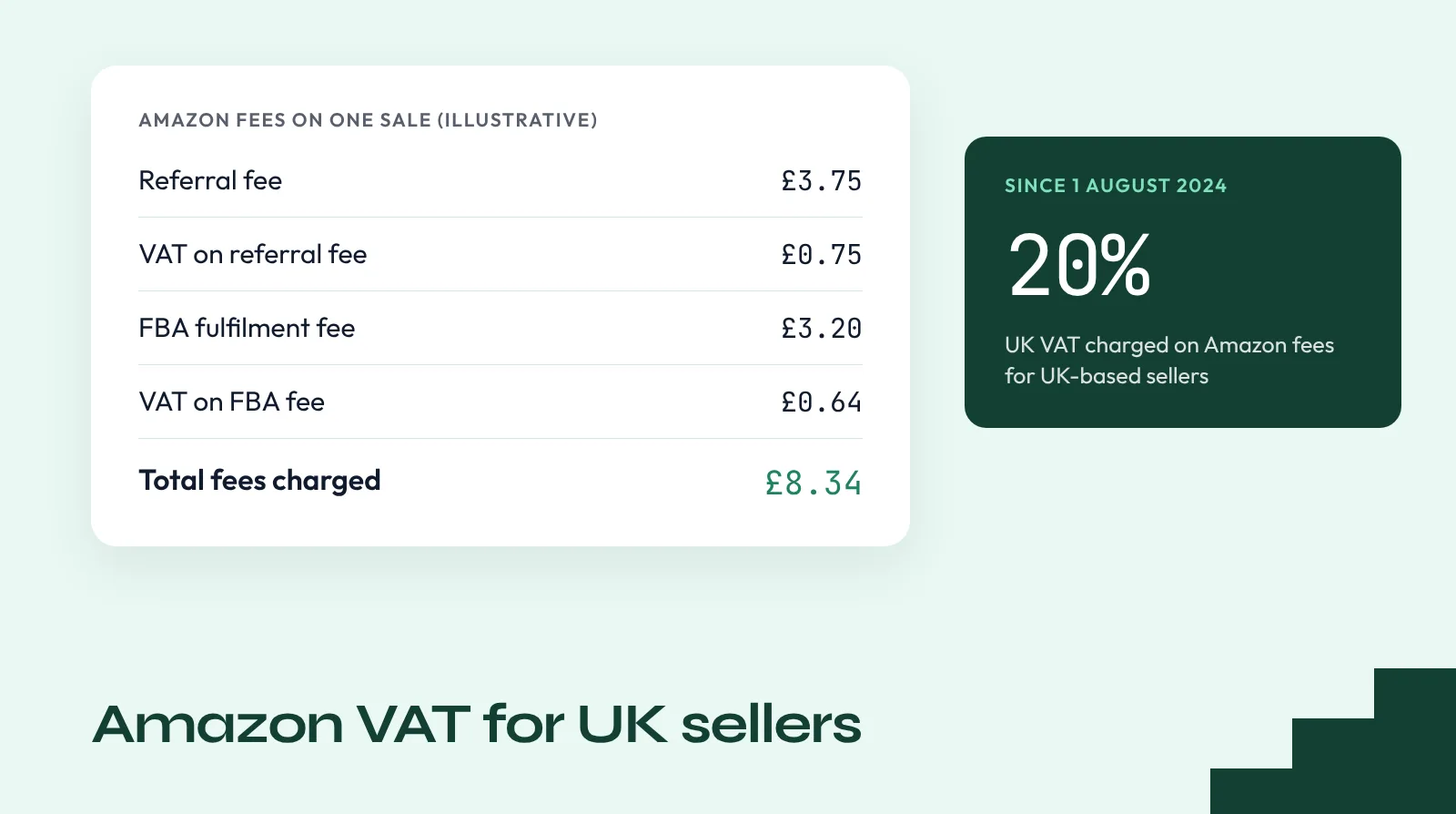
This changed on 1 August 2024. Amazon moved its seller services from Amazon Services Europe to Amazon EU S.à r.l., with sellers invoiced by the branch in their country of establishment. For UK-established sellers that means the UK branch, and UK VAT at 20% is now charged on Amazon’s fees, including referral fees and FBA fees.
What it means for you depends on your VAT position:
| Your position | Effect of VAT on Amazon fees |
|---|---|
| VAT registered, standard scheme | Normally reclaimable as input tax, using Amazon’s VAT invoices. A cash flow cost until you reclaim it. |
| VAT registered, Flat Rate Scheme | Generally can’t be reclaimed, because the Flat Rate Scheme doesn’t let you reclaim VAT on most purchases. Worth reviewing whether the scheme still suits you. |
| Not VAT registered | A real cost: Amazon’s fees are 20% higher than they were for you before August 2024. |
Here’s an illustrative example for one sale, with invented figures: a £3.75 referral fee plus £0.75 VAT, and a £3.20 FBA fee plus £0.64 VAT, so £8.34 in fees in total. A VAT-registered seller on the standard scheme reclaims the £1.39. A seller who isn’t registered can’t.
To reclaim, you need the VAT invoices. Download Amazon’s monthly fee invoices from Seller Central rather than relying on the settlement report, and make sure your bookkeeping records the VAT on fees separately from the net fee.
When Amazon collects the VAT instead
Since 1 January 2021, online marketplaces have been responsible for VAT in two situations. GOV.UK’s guidance on VAT and overseas goods sold through online marketplaces sets them out:
- Imported consignments worth £135 or less sold through a marketplace to customers in Great Britain: the marketplace charges UK VAT at the point of sale.
- Goods of any value already in the UK at the point of sale, sold by an overseas business through a marketplace: the marketplace is liable for the VAT.
Neither applies to a UK-established seller selling stock held in the UK, which is most of our clients. If you’re UK-based, don’t assume Amazon is dealing with your VAT. It isn’t.
Selling into Europe
If you sell to EU customers from UK stock, those are exports, and the VAT treatment depends on the value and on whether you use the EU’s IOSS scheme. Our guide to IOSS and exporting covers it.
If Amazon stores your stock in an EU country, for example through a European fulfilment programme, you’ll generally need to register for VAT in that country, because you’re making sales from stock held there.
Common Amazon VAT mistakes
- Registering late. Not watching the rolling 12-month total, then owing VAT on sales already made at VAT-inclusive prices.
- VAT on the payout instead of the sale. Understates the VAT due.
- VAT on Amazon fees not reclaimed. Fees booked at the gross amount with no VAT recorded.
- Zero-rated products charged at 20%. VAT overpaid on every sale.
- Assuming Amazon handles it. The marketplace rules apply to overseas sellers, not UK ones.
Getting it right every month
Amazon VAT is manageable once the settlement data flows into your books properly: sales and refunds with the right VAT rate, fees with their VAT, and everything matched to the bank before the VAT return is prepared. That’s how we work with Amazon sellers, as part of our VAT and MTD service. If you’d like your Amazon VAT checked, book a free discovery call.


