


Upcoming tax changes for UK online sellers, 2026 to 2031
In short
UK online sellers face several announced changes over the next five years. Making Tax Digital for Income Tax reaches sole traders with qualifying income over £30,000 from 6 April 2027 and over £20,000 from 6 April 2028. All VAT invoices must be electronic from 2029. The UK's £135 customs duty relief on low-value imports ends by March 2029 at the latest, and Income Tax thresholds stay frozen until April 2031. This timeline lists each change with its date and official source.
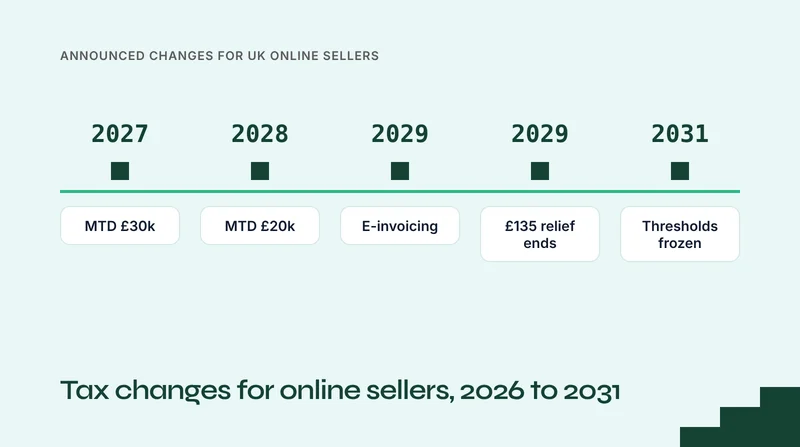
Tax rules for online sellers are changing faster than at any time in the last decade. Some changes are already law with fixed dates; others are announced, with details still to come. This timeline brings together everything announced so far that affects UK sellers on Amazon, Shopify, eBay, Etsy and TikTok Shop, with the official source for each.
Last checked: 9 October 2026. We update this page after each Budget.
Already in force in 2026
| Since | Change | Source |
|---|---|---|
| 6 April 2026 | MTD for Income Tax applies to sole traders and landlords with qualifying income over £50,000 in 2024/25 | GOV.UK |
| January 2026 | TikTok Shop UK commission rose from 6% to 9% for most categories | Tiklytics (third-party) |
| 12 February 2026 | eBay UK per-order fee rose to 40p on orders over £10 | eBay |
| 1 July 2026 | EU charges a temporary €3 customs duty per item on parcels worth €150 or less | European Commission |
The timeline: 2027 to 2031
| Date | Change | Who it affects | Source |
|---|---|---|---|
| 6 April 2027 | MTD for Income Tax threshold falls to £30,000 | Sole traders with 2025/26 qualifying income over £30,000 | GOV.UK |
| 6 April 2027 | Penalty points for late MTD quarterly updates begin | Everyone in MTD for Income Tax | GOV.UK |
| 6 April 2027 | Company cars, fuel, vans and medical benefits must be payrolled | Employers providing these benefits | GOV.UK |
| 6 April 2028 | MTD for Income Tax threshold falls to £20,000 | Sole traders with 2026/27 qualifying income over £20,000 | GOV.UK |
| From April 2028 | Small and micro companies file a profit and loss account, via software only | Limited companies | GOV.UK |
| 1 July 2028 | EU replaces the €3 flat duty with normal duty rates | UK sellers shipping to EU consumers | European Commission |
| 2029 | All VAT invoices must be e-invoices | VAT-registered businesses | GOV.UK |
| By March 2029 | UK removes the £135 customs duty relief on low-value imports | Sellers importing small consignments | GOV.UK |
| Until 5 April 2031 | Personal Allowance frozen at £12,570; higher rate threshold at £50,270 | All taxpayers | GOV.UK |
What each change means for online sellers
Making Tax Digital for Income Tax reaches smaller sellers
MTD for Income Tax started on 6 April 2026 for sole traders with qualifying income over £50,000. The threshold falls to £30,000 from 6 April 2027 and £20,000 from 6 April 2028. Because qualifying income is turnover before expenses, many Etsy, eBay and TikTok Shop sellers with modest profits will be brought in. From the 2027/28 tax year, late quarterly updates also start earning penalty points, with a £200 penalty at four points.
What to do: work out your qualifying income from gross sales across every channel, and move your records into MTD-compatible software well before your start date. Our guide to MTD for Income Tax covers the detail.
E-invoicing for every VAT invoice from 2029
The government has announced that all VAT invoices must be issued and received electronically from 2029, with a roadmap due at Budget 2026. For marketplace sellers selling to consumers this may mostly affect purchase invoices and B2B sales, but the details are still to be published.
What to do: when choosing or renewing accounting software, check it supports e-invoicing. Xero and QuickBooks both publish their plans.
Low-value imports lose their duty relief
At Autumn Budget 2025, the government announced that the £135 customs duty relief on low-value imports will be removed by March 2029 at the latest, with new customs arrangements for these goods. Sellers who import stock in small parcels, or drop-ship from overseas, will see duty added to costs that are currently duty-free.
What to do: check which of your products arrive in consignments of £135 or less, and model the duty using the right commodity code. Our commodity code lookup and import duty calculator help with both.
Shipping to the EU costs more per item
Since 1 July 2026, the EU has charged a temporary €3 customs duty on each item in parcels worth €150 or less, ending the previous duty-free treatment. From 1 July 2028 the flat fee is replaced by normal duty rates for each type of product.
What to do: if you sell to EU consumers, include the €3 per item in your landed cost for EU orders now, and review again in 2028.
Companies House accounts filing changes
Companies House plans to require small and micro companies to file a profit and loss account, with an option to keep it off the public register, and to file accounts only through software. The changes are now expected from April 2028.
What to do: nothing yet if your accountant already files through software, but expect more information to be filed.
Frozen thresholds until 2031
The Personal Allowance stays at £12,570 and the higher rate threshold at £50,270 until 5 April 2031. As profits rise with inflation, more of them are taxed, and more sole traders reach the higher rate. This is often the point at which trading through a limited company becomes worth reviewing.
Benefits in kind move into payroll
From 6 April 2027, employers must report company cars, fuel, vans and employer-provided medical benefits through payroll in real time, rather than on P11D forms. Most remaining benefits follow from April 2028. Our payroll service covers the switch.
Stay ahead of the changes
Most of these changes reward sellers who already keep accurate, digital, reconciled records. If you want to know which changes affect your business and when, book a discovery call and we will map them against your figures.


