


Making Tax Digital for Income Tax: what online sellers need to do
In short
Making Tax Digital for Income Tax applies to sole traders and landlords whose qualifying income, meaning turnover before expenses, is over £50,000 from April 2026, over £30,000 from April 2027 and over £20,000 from April 2028. Once in, you keep digital records, send HMRC a quarterly update through compatible software and still file a tax return by 31 January. Limited companies are not affected.
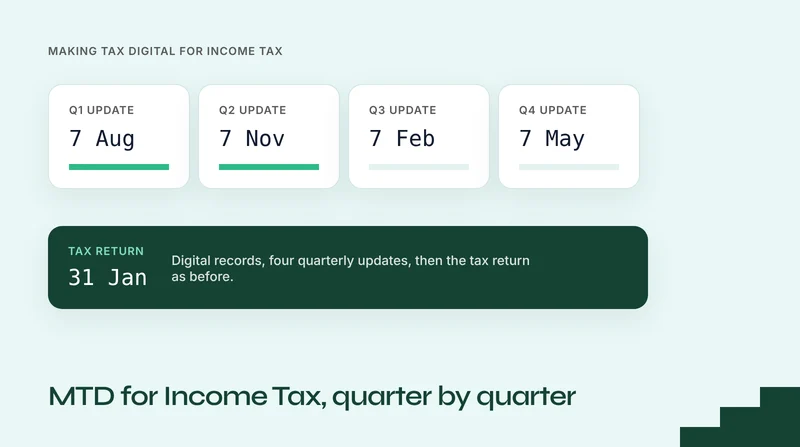
Making Tax Digital for Income Tax is the biggest change to Self Assessment in a generation, and online sellers feel it early. Because the threshold is measured on turnover rather than profit, a seller with healthy sales and thin margins can be brought in long before a service business with the same profit.
This guide explains who has to join and when, what changes in practice, and how to get ready without a last-minute scramble.
Who has to use MTD for Income Tax, and when
MTD for Income Tax applies to sole traders and landlords registered for Self Assessment. When you must start depends on your qualifying income on an earlier tax return.
| Qualifying income on your return for | Is over | You must start from |
|---|---|---|
| 2024 to 2025 | £50,000 | 6 April 2026 |
| 2025 to 2026 | £30,000 | 6 April 2027 |
| 2026 to 2027 | £20,000 | 6 April 2028 |
Source: GOV.UK. If you were over £50,000 for 2024 to 2025, you should already have started. You can still sign up, and an agent can sign you up for you.
Limited companies are not in MTD for Income Tax. They pay Corporation Tax and file company accounts instead. If you trade through a company, MTD for Income Tax only matters for any self-employment or property income you have personally.
What counts as qualifying income
Qualifying income is your gross income from self-employment and property, added together, before any expenses. Wages taxed through PAYE, pensions and dividends do not count.
For an online seller, that has two consequences:
- It is your sales figure, not your profit. A reseller with £55,000 of sales and £15,000 of profit is over the £50,000 line.
- It is gross sales, not payouts. Marketplace payouts have fees, refunds and advertising taken off. If you track income by what reaches the bank, you may think you are under the threshold when you are not.
Getting the sales figure right is what our multi-platform reconciliation does: it rebuilds gross sales from each marketplace’s settlement data, so the number HMRC sees is the real one.
What changes once you are in
1. Digital records
You must keep records of your income and expenses digitally, in MTD-compatible software. Spreadsheets can only be used with bridging software that sends the figures to HMRC. For most sellers, accounting software such as Xero or QuickBooks, connected to each sales channel, is far simpler.
2. Quarterly updates
Every quarter, you send HMRC a summary of income and expenses by category. Each update is cumulative from the start of the tax year, and no tax is paid with it. You choose standard or calendar periods in your software before your first update.
| Standard period | Calendar period | Deadline |
|---|---|---|
| 6 April to 5 July | 1 April to 30 June | 7 August |
| 6 April to 5 October | 1 April to 30 September | 7 November |
| 6 April to 5 January | 1 April to 31 December | 7 February |
| 6 April to 5 April | 1 April to 31 March | 7 May |
3. The tax return is still due
You still submit a tax return for the year by 31 January after the tax year ends. It is where adjustments, allowances and any other income are added, and where your final tax is worked out.
Penalties
MTD for Income Tax uses a points-based system for late submissions, according to GOV.UK:
- each missed deadline earns a penalty point
- reaching 4 points triggers a £200 penalty, with a further £200 for each later missed deadline
- late quarterly updates only earn points for tax years after 2026 to 2027, so the first year is a chance to get the routine right
Late payment of tax is penalised separately, with interest.
Getting ready: a checklist for online sellers
- Work out your qualifying income from gross sales across every channel, plus any property income.
- Move your records into MTD-compatible software now, rather than at the start of a tax year when everything else is busy.
- Connect your sales channels. For Amazon, Shopify, eBay and Etsy we use A2X, so each settlement is split into sales, fees and refunds automatically.
- Pick standard or calendar quarters to suit how you run the business.
- Put the deadlines in your diary: 7 August, 7 November, 7 February, 7 May and 31 January.
- Keep putting tax aside monthly. Quarterly updates do not change when you pay, so the January bill still needs planning.
Should you think about incorporating?
MTD for Income Tax alone is not a reason to set up a limited company. Incorporating changes how you are taxed, how you take money out and what you must file, and it suits some sellers far better than others. Our Etsy accountants page works through the comparison for sole traders.
How we help
For sole trader sellers, we sign you up for MTD for Income Tax, connect your channels, keep your records digital and file each quarterly update and your tax return, as part of our VAT returns and MTD service. If you are not sure whether you are in yet, book a discovery call and we will work out your qualifying income from your actual sales data.


