


How to calculate break-even ROAS
In short
Break-even ROAS is the return on ad spend at which advertising pays for itself and no more. It equals 1 divided by your contribution margin: the share of each sale left after cost of goods, platform fees and delivery, before advertising. A product with a 40% contribution margin breaks even at a ROAS of 2.5. Anything above that makes a profit, anything below loses money on every sale.
Return on ad spend tells you how much revenue each pound of advertising brings in. On its own, it does not tell you whether that advertising made any money. A ROAS of 4 sounds healthy, but for a product with thin margins it can still lose money on every sale.
Break-even ROAS is the number that answers that question. It is the ROAS at which advertising exactly pays for itself. Above it, ads are profitable. Below it, every sale they win costs you money. This guide shows how to calculate it, how VAT changes the answer, and how to set a target ROAS that leaves a profit.
What ROAS measures
ROAS is revenue from advertising divided by what you spent on it:
ROAS = revenue from ads ÷ ad spend
Spend £1,000 on Meta or Google Ads, record £4,000 of sales from them, and your ROAS is 4. The ad platform reports this for you. What it does not know is how much of that £4,000 you actually keep after paying for the product, the platform fees and delivery.
The break-even ROAS formula
To break even, the profit from a sale before advertising must exactly cover the advertising cost. That gives:
Break-even ROAS = 1 ÷ contribution margin
Your contribution margin is the share of each sale left after:
- cost of goods, using your landed cost per unit including freight and duty
- platform and payment fees, such as marketplace commission and card fees
- delivery and packaging you pay for
- VAT, if you are VAT-registered, because it belongs to HMRC
It does not take off advertising, because that is what you are solving for, or fixed overheads such as rent and salaries, which do not change with each sale.
Worked example: a Shopify product
A VAT-registered seller sells a product on Shopify for £30 including VAT.
| Line | Per sale |
|---|---|
| Selling price including VAT | £30.00 |
| VAT at 20% (one sixth) | −£5.00 |
| Net revenue | £25.00 |
| Landed cost of goods | −£9.00 |
| Shopify Payments (2% + 25p of £30) | −£0.85 |
| Delivery and packaging | −£3.40 |
| Profit before advertising | £11.75 |
Illustrative figures. Contribution margin is £11.75 ÷ £25.00 = 47%.
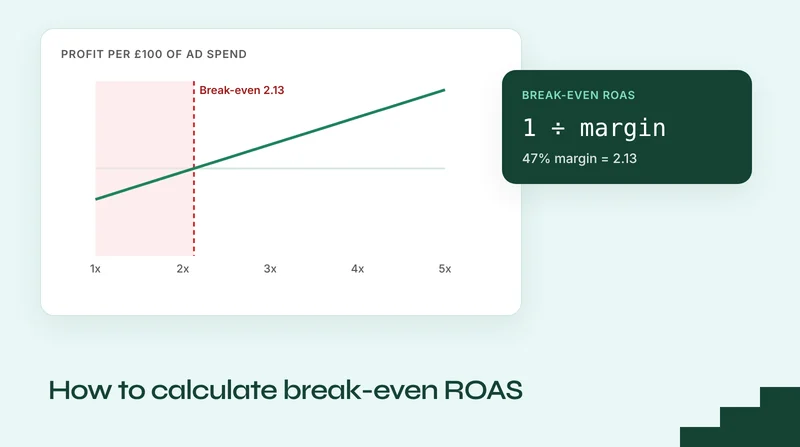
So break-even ROAS on net revenue is 1 ÷ 0.47 = 2.13. Put another way, the most you can spend on ads to win one sale without losing money is £11.75. That figure is your break-even cost per acquisition (CPA).
The VAT trap
Most ad platforms report the revenue they are sent, and for many UK stores that figure includes VAT. If your ROAS figures include VAT, your break-even figure must too:
Break-even ROAS on VAT-inclusive revenue = £30.00 ÷ £11.75 = 2.55
The difference matters. A campaign reporting a ROAS of 2.3 looks profitable against 2.13 but is losing money against 2.55. Check how your store sends revenue to each ad platform before you compare against a target.
Break-even ACoS on Amazon
Amazon Ads uses ACoS (advertising cost of sale) rather than ROAS. ACoS is ad spend divided by ad sales, so it is simply the inverse:
ACoS = 1 ÷ ROAS, and break-even ACoS = profit before advertising ÷ selling price
Take a product selling for £24.99 including VAT through FBA:
| Line | Per unit |
|---|---|
| Selling price including VAT | £24.99 |
| VAT (one sixth) | −£4.17 |
| Landed cost of goods | −£11.95 |
| Referral fee (15% of £24.99) | −£3.75 |
| FBA fulfilment fee | −£3.00 |
| Profit before advertising | £2.12 |
Illustrative figures, using our Amazon FBA profit calculator defaults. Break-even ACoS is £2.12 ÷ £24.99 = 8.5%, which is a break-even ROAS of about 11.8.
Few Amazon campaigns run at an ACoS that low. A product like this cannot support much advertising at all, which is exactly what the number is for: it tells you to fix the price or the landed cost before spending more on ads.
Break-even ROAS by margin
| Contribution margin | Break-even ROAS | Break-even ACoS |
|---|---|---|
| 20% | 5.00 | 20% |
| 25% | 4.00 | 25% |
| 33% | 3.00 | 33% |
| 40% | 2.50 | 40% |
| 50% | 2.00 | 50% |
| 60% | 1.67 | 60% |
Use the same revenue basis, with or without VAT, for the margin and the ROAS you compare it with.
From break-even to a target ROAS
Breaking even on ads still leaves nothing to pay overheads or make a profit. To set a target, decide what profit you want from each sale after advertising, and work back:
Target ROAS = net revenue ÷ (profit before advertising − target profit)
In the Shopify example, a seller wanting 15% of net revenue (£3.75) left after advertising can spend £11.75 − £3.75 = £8.00 on ads per sale. Target ROAS is £25.00 ÷ £8.00 = 3.13 on net revenue, or 3.75 on VAT-inclusive revenue.
Five mistakes that make break-even ROAS wrong
- Using the supplier price instead of landed cost. Freight and duty belong in cost of goods. Our import duty calculator works out landed cost per unit.
- Mixing VAT bases. Comparing VAT-inclusive ROAS with a margin worked out without VAT makes campaigns look better than they are.
- Forgetting fees and delivery. Marketplace commission, card fees and postage come off every order.
- Using one margin for the whole store. A store-wide average hides products that cannot support advertising. Work out break-even ROAS by product, or at least by product group.
- Ignoring returns. If one order in ten is returned, the real profit per sale is lower. Allow for your return rate in the margin.
Blended ROAS and repeat customers
Platform ROAS only counts sales the ad platform claims. Blended ROAS, also called marketing efficiency ratio (MER), divides total revenue by total ad spend across every channel. It is a useful check that platforms are not all claiming the same sales.
If customers buy again, the first order is not the whole story. Some sellers accept a ROAS below break-even on the first sale because a customer is worth more over time. That is a valid strategy only if you know your repeat rate from real data and have the cash flow to fund the gap until those repeat orders arrive.
Put it into practice
- Work out profit before advertising for your main products. Our gross margin calculator shows the margin after fees and delivery.
- Calculate break-even ROAS or ACoS for each, on the same VAT basis as your ad platforms.
- Set a target above break-even that leaves the profit you need.
- Review it whenever your landed cost, prices or fees change.
Break-even ROAS is only as good as the cost figures behind it. We build margin by product from reconciled sales and landed costs every month, so the numbers you set ad targets from are real. Book a discovery call to see what that looks like for your store.


