


How to switch accountants without missing a deadline
In short
Switching accountants in the UK takes a few weeks and you do not need to wait for your year end. You appoint the new accountant, they send a professional clearance letter to your old one, you authorise them with HMRC and Companies House, and your records and bookkeeping software are handed over. This guide sets out each step, the timing that causes least disruption, and the records to ask for.
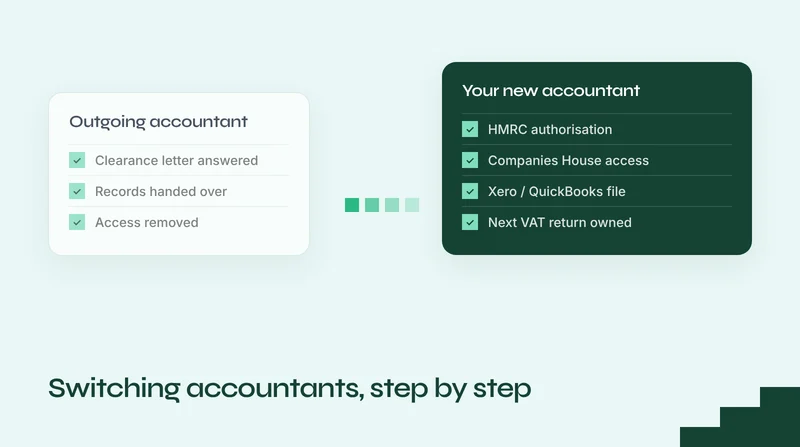
Changing accountants feels like a bigger job than it is. Your records, your tax history and your bookkeeping file all belong to your business, and the handover between two firms follows a well-worn process. Done in the right order, you can switch accountants in a few weeks without missing a VAT return, a payroll run or a filing deadline.
This guide walks through the process step by step, from deciding when to move to the first month with your new accountant. It is written for UK limited companies and sole traders, with notes for online sellers whose accounts depend on marketplace data.
Signs it is time to switch accountants
Most people do not leave an accountant over one mistake. They leave because the service no longer fits the business. Common reasons include:
- You only hear from them at year end. You want monthly figures and someone to explain them, not an annual set of accounts nine months after the period closed.
- The numbers do not match reality. Revenue looks wrong, fees sit in one lump, stock is never valued, or the VAT return is built from bank deposits.
- Your business has outgrown them. You have added channels, started importing, registered for VAT or taken on staff, and the advice has not kept up.
- Questions go unanswered. You do not know who is doing your work, and replies take days.
For online sellers, the gap is often specialist knowledge. Our guide on why generic accountants cost eCommerce sellers thousands covers the six errors we see most when marketplace accounts are treated like an ordinary business.
When is the best time to change accountants?
You do not need to wait for your year end. The simplest rule is to switch so that each filing belongs clearly to one firm.
- Just after a VAT return is filed. The new accountant starts with a clean quarter and owns every return from then on.
- Before year end work starts. If your year end has passed but the accounts are not yet prepared, it is usually better for the new accountant to prepare them, so they understand the figures they will build on.
- Not in the final weeks before a deadline. If a VAT return, confirmation statement or Corporation Tax return is due within a few weeks, agree that the outgoing firm finishes it, or allow enough time for the new firm to be authorised first.
Check your engagement letter for the notice period. Many firms ask for one month or more, and some invoice for work in progress when you leave.
The process, step by step
Here is how switching accountants works in practice, in the order it usually happens.
1. Choose and appoint your new accountant
Agree the scope of work, the fee and the start date in an engagement letter. Be clear about who prepares the next VAT return, the next payroll and the year end accounts, so there is no gap and no duplication.
Your new accountant will also carry out anti-money laundering checks before they can act for you. Expect to provide photo ID and proof of address for directors and anyone with significant control of the company.
2. Tell your current accountant
Let your current accountant know you are moving, ideally by phone or email before the new firm writes to them. Confirm in writing that you consent to them speaking to your new accountant and sharing your information. Ask for the final invoice now, so it can be settled or queried early.
3. Professional clearance
Your new accountant sends a professional clearance letter (also called a professional enquiry) to the outgoing firm. It asks whether there is any professional reason they should not take you on, and requests handover information.
ICAEW guidance for its members says the outgoing accountant should respond promptly and deal promptly with reasonable requests to transfer records. Outstanding fees are not a reason to refuse to reply, although in some circumstances an accountant may hold a lien over certain records until fees are paid. In practice, the most common cause of delay is an unpaid or disputed final invoice.
4. Authorise your new accountant with HMRC
Your new accountant cannot speak to HMRC or file returns for you until you authorise them. GOV.UK explains that this is normally done online, with the paper 64-8 form used only where an online route is not available.
You will need to authorise them for each tax they handle, typically:
- VAT, so they can file your VAT returns through Making Tax Digital software
- Corporation Tax for a limited company
- PAYE if you run payroll
- Self Assessment for directors or sole traders whose personal return they prepare
Once your new accountant is authorised, ask your old accountant to remove their own authorisation, or remove it yourself from your business tax account.
5. Give access to Companies House
For a limited company, your new accountant needs to be able to file your annual accounts and confirmation statement. This usually means sharing your company authentication code. Companies House also began requiring directors to verify their identity in November 2025, with existing directors confirming theirs alongside the company’s confirmation statement. If you have not done this yet, your new accountant can tell you how.
6. Hand over your records
Ask for, or have your new accountant request, the records they need to pick up where the old firm left off. The checklist below covers the usual items.
| Record | Why the new accountant needs it |
|---|---|
| Last two years of statutory accounts and Corporation Tax returns | Opening balances and tax history |
| Final trial balance and year end working papers | How the closing figures were built |
| VAT returns filed since the last year end | What has already been declared to HMRC |
| Fixed asset register and capital allowances computations | Correct depreciation and allowances going forward |
| Director’s loan account and loan agreements | Balances that carry tax consequences |
| Payroll records, P60s and year-to-date figures | Payroll continues mid-year without errors |
| Postponed import VAT statements and C79s | Import VAT reclaimed once, and only once |
| Stock valuation at the last year end | The opening figure for cost of goods sold |
7. Move your bookkeeping software
Your Xero or QuickBooks file belongs to your business. Either the subscription moves to the new accountant’s account, or they are invited as an adviser on your existing file. Either way, your transaction history stays intact. Remove the old firm’s user access once the handover is complete.
If you sell online, this is also the time to check how your marketplace data reaches the books. For Amazon, Shopify, eBay and Etsy we connect settlements through A2X, so each payout is split into sales, fees, refunds and VAT. Our multi-platform reconciliation service explains how that works.
8. Review and first month
A good new accountant reviews what they inherit before filing anything. That review often finds the issues that prompted the switch: settlements posted as net payouts, stock that was never valued, or import VAT treated as a cost. Fixing them before the next VAT return or year end is far cheaper than unwinding them later.
From then on, you should know exactly who is doing your work, when you will see your numbers, and what each monthly fee covers.
Common mistakes to avoid
- Leaving a deadline in no man’s land. Agree in writing which firm files the next VAT return, payroll run and accounts.
- Forgetting payroll. If the old firm runs your payroll, plan the switch around a pay date and pass on the year-to-date figures, so employees’ tax codes and pension contributions carry on correctly.
- Not settling the final invoice. An outstanding bill is the most common reason a handover stalls.
- Leaving the old firm’s access in place. Remove HMRC authorisations and software access once the handover is done.
- Switching to another generalist. If your business sells online, imports stock or runs several channels, ask how the new firm handles settlements, landed costs and marketplace VAT before you appoint them.
Switching to eCounts
If you sell on Amazon, Shopify, eBay or Etsy, switching to us follows the steps above. We handle the professional clearance letter and the HMRC and Companies House requests, set up your reconciliation, and review your records before the next return is due. Your accounts are led by an ICAEW chartered accountant, Xero or QuickBooks is included in the fee, and our agreements are rolling monthly with no minimum term.
You can compare our fixed monthly fees on the pricing page, or book a discovery call and we will tell you what the switch would involve for your business.


