


IOSS and exporting: VAT on overseas sales for UK online sellers

Reviewed by Alex Gillespie
, ICAEW chartered accountant
In short
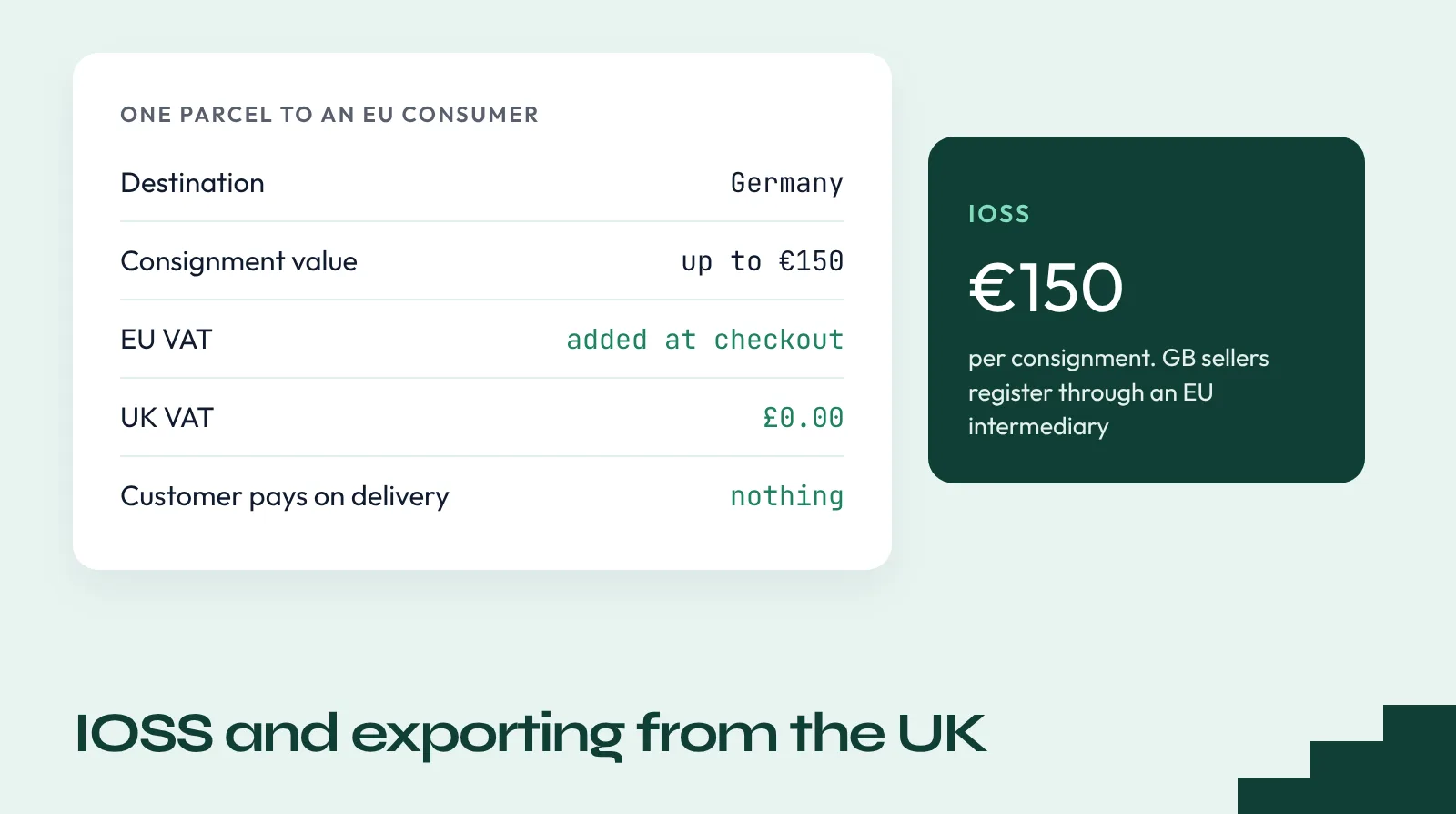
Most goods sent from Great Britain to customers abroad are zero-rated exports, as long as you keep proof the goods left the UK. For parcels up to €150 sent to EU consumers, the EU's Import One Stop Shop (IOSS) lets you charge EU VAT at checkout so customers aren't hit with charges on delivery. GB sellers can only use IOSS through an EU-based intermediary.
Selling abroad is one of the quickest ways for a UK brand to grow, and one of the easiest ways to get VAT wrong. The rules depend on two things: where the parcel goes, and whether the customer is a consumer or a business.
This guide covers the VAT position for each type of overseas order, how the EU’s Import One Stop Shop works for GB sellers, and the evidence you need to keep.
The four types of overseas order
| Order | UK VAT | What happens at the border | What to keep |
|---|---|---|---|
| EU consumer, parcel up to €150, using IOSS | None | Nothing for the customer to pay. EU VAT was charged at checkout | IOSS records and checkout VAT by country |
| EU consumer, without IOSS | Zero-rated export | The customer pays import VAT and a handling fee on delivery | Proof of export |
| Business abroad, such as a salon or stockist | Zero-rated export | The buyer accounts for import VAT in their own country | Proof of export within 3 months |
| Consumer in the US, Australia or elsewhere | Zero-rated export | Local import taxes may apply to the customer | Proof of export |
Zero-rated means the sale is still a taxable supply, and counts towards your VAT registration threshold, but at 0%. You can still reclaim the VAT on your costs.
How IOSS works for UK sellers
Since July 2021, the EU charges import VAT on every parcel, however small. Without IOSS, a customer in Germany or France pays that VAT plus a courier handling fee before they can have their order. That’s a common reason for refused deliveries and bad reviews.
IOSS fixes this for consignments worth up to €150. You charge the customer’s local VAT rate at checkout, the parcel clears customs without further charges, and you pay the VAT through one monthly IOSS return.
Three points matter for GB sellers:
- You need an intermediary. GOV.UK says businesses in Great Britain must ask an intermediary to register and act for them. Budget for their fee.
- Marketplaces may already handle it. On Amazon, eBay and Etsy, the marketplace often collects EU VAT on low-value sales itself. IOSS matters most for sales through your own Shopify or WooCommerce store.
- €150 is per consignment. Items sent together count together. Bigger orders fall outside IOSS.
Your IOSS number
Once registered, your intermediary gives you an IOSS number. It goes into the electronic customs data your courier or Royal Mail sends with each parcel, which is how EU customs knows VAT has already been paid. Share it only with your carriers, not publicly, because a misused number can create charges against your account.
What IOSS doesn’t cover
- Consignments over €150. Normal import rules apply, with VAT and any duty paid at customs clearance.
- Goods subject to excise duties, such as alcohol and tobacco, whatever their value.
- Sales through a marketplace. Where Amazon, eBay or Etsy facilitates the sale, the marketplace is treated as the deemed supplier and charges EU VAT using its own IOSS number. You don’t charge it again.
Northern Ireland and EU stock: OSS, not IOSS
IOSS is for goods imported into the EU. Two situations work differently:
- Selling from Northern Ireland. Goods sent from Northern Ireland to EU consumers aren’t imports, because Northern Ireland follows EU VAT rules for goods. These are distance sales, reported through the Union One Stop Shop (OSS), which HMRC runs for Northern Ireland businesses.
- Selling from stock held in the EU. If you hold stock in an EU warehouse, sales from it aren’t imports either. You usually need an EU VAT registration, and sales to consumers in other EU member states can go through OSS.
Proof of export: the part most sellers forget
Zero-rating depends on evidence. If HMRC asks and you can’t show the goods left the UK, the sale can be treated as UK standard-rated and you owe 20% VAT on it, even though you never charged it.
Good evidence includes:
- Courier or Royal Mail tracking showing delivery abroad
- The commercial invoice and any customs declaration
- Transport documents from your freight forwarder
- For business customers, their name, address and order details
Most sellers already have this in Shopify and their courier accounts. The risk is not having it; it’s not being able to pull it together when asked.
“The sellers who get caught out aren’t doing anything wrong. They’re zero-rating overseas sales correctly but can’t produce the courier evidence a year later. A monthly export file from Shopify and your courier solves it.”
Alex Gillespie, ICAEW chartered accountant
Common mistakes
- Charging UK VAT on overseas consumer orders. Your store may be set to add 20% everywhere. That overcharges customers and inflates your VAT bill.
- Leaving overseas sales out of the VAT threshold. Zero-rated exports still count towards the £90,000 registration threshold.
- Reporting IOSS sales on the UK VAT return. IOSS sales belong on the IOSS return, not as standard-rated UK sales.
- Using IOSS above €150. Consignments over the limit need normal import clearance.
- Holding stock in an EU warehouse without checking VAT. Goods sold from stock inside the EU are not UK exports, and usually need an EU VAT registration.
Getting it right in your books
Overseas sales should be tagged by destination and customer type in Xero or QuickBooks, so your VAT return, any IOSS return and your margin reports all agree. Our VAT returns service handles UK, EU and export VAT for online sellers, and our reconciliation service splits multi-currency payouts properly. Book a discovery call if you sell abroad and aren’t sure your VAT is set up right.


