


When do online sellers need to register for VAT?
In short
A UK online seller must register for VAT when taxable turnover in any rolling 12 months goes over £90,000, or is expected to go over £90,000 in the next 30 days alone. Turnover means gross sales across every channel, not the payouts that reach your bank. This guide explains both tests, how marketplace sales count, when voluntary registration makes sense and what changes once you are registered.
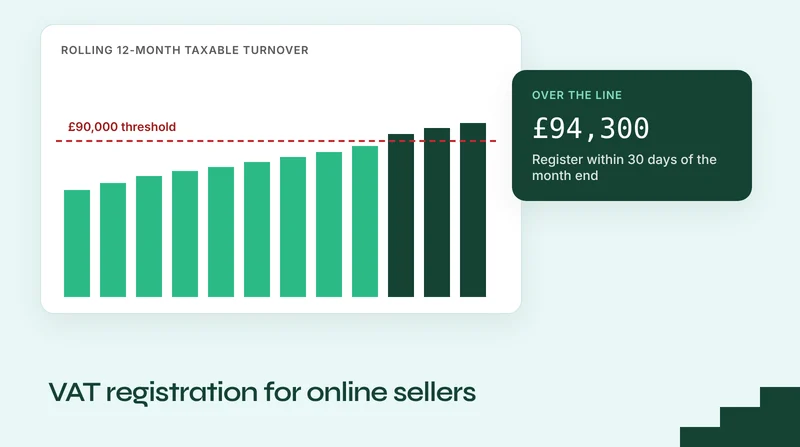
For most online sellers, VAT registration arrives faster than expected. Sales climb through Q4, the rolling 12-month total crosses the line in a month nobody was watching, and the 30-day deadline has passed before anyone checks. Registering late does not make the VAT go away: it is owed from the date you should have registered, whether or not you charged it.
This guide explains exactly when a UK online seller must register for VAT, how marketplace sales count, and how to plan for the change in price and margin.
The VAT registration threshold
The VAT registration threshold is £90,000 of taxable turnover. You must register if either of these is true:
- The rolling 12-month test. Your taxable turnover for the last 12 months has gone over £90,000.
- The 30-day forward-look test. You expect your taxable turnover to go over £90,000 in the next 30 days alone.
You can cancel your registration later if taxable turnover falls below the deregistration threshold of £88,000. The full rules are on GOV.UK: register for VAT.
How the rolling 12-month test works
The test looks back over the last 12 months at the end of every month. It is not tied to the tax year or your accounting year end.
| Month end | Sales in month | Rolling 12-month total | Over £90,000? |
|---|---|---|---|
| August | £6,200 | £81,400 | No |
| September | £7,100 | £83,900 | No |
| October | £8,400 | £87,600 | No |
| November | £11,900 | £94,300 | Yes |
Illustrative figures. In this example the seller goes over the threshold at the end of November. They must tell HMRC within 30 days of the end of that month, so by 30 December, and they are registered from 1 January, the first day of the second month after going over.
How the 30-day test works
The forward-look test catches a single large expected order or a sudden step up in sales. If at any point you expect taxable turnover in the next 30 days alone to go over £90,000, you must register by the end of that 30-day period, and you are registered from the date you realised. For most online sellers this is rare, but it can apply to a large wholesale order or a business that has just bought another.
What counts as taxable turnover for an online seller
Taxable turnover is the total value of everything you sell that is not VAT exempt or outside the scope of VAT. For an online seller, that means:
- Gross sales, not payouts. A marketplace payout is your sales less fees, refunds and advertising. The threshold is measured on the sales figure, so a seller who tracks the money reaching the bank will understate turnover.
- Every channel added together. Amazon, eBay, Etsy, TikTok Shop, Shopify and in-person sales all count towards one figure.
- Zero-rated sales. Items such as most children’s clothing and books are zero-rated, but they still count towards the threshold.
- Postage you charge. Delivery charged to customers is part of the sale.
This is why accurate records matter before you are registered, not just after. If your accounts are built from bank deposits, the turnover figure you are checking is already wrong. Our multi-platform reconciliation service rebuilds gross sales from each marketplace’s own settlement data.
Marketplace sales and VAT
Online marketplaces account for VAT on some sales and not others, and that causes a lot of confusion.
| Situation | Who accounts for the VAT |
|---|---|
| UK-established seller, goods held in the UK, sold through a marketplace | You, the seller |
| Overseas seller, goods held in the UK, sold through a marketplace | The marketplace |
| Goods outside the UK in a consignment of £135 or less, sold through a marketplace | The marketplace |
| Goods you import for resale | You, as import VAT |
For a UK-established seller, the marketplace does not take care of VAT on your sales. Your marketplace sales count towards your threshold and, once you are registered, go on your VAT return. Our VAT returns service page covers the wider rules, including Northern Ireland and EU sales.
Should you register voluntarily?
You can register for VAT below the threshold. Whether it helps depends on who your customers are and what you spend.
It can make sense if:
- most of your customers are VAT-registered businesses, who can reclaim the VAT you charge
- you import large volumes of stock and want to recover import VAT, ideally through postponed VAT accounting
- you are close to the threshold and growing, and would rather set prices once
It usually does not make sense if:
- you sell mainly to consumers, who cannot reclaim VAT, so you either raise prices by up to 20% or absorb it from margin
- your costs carry little VAT, so there is not much to reclaim
Run your own numbers before deciding. The Amazon, Shopify, eBay and Etsy profit calculators each have a VAT switch, so you can see what a sale earns either way.
What changes once you are registered
- Pricing. For sales to consumers, one sixth of a VAT-inclusive price at the 20% standard rate is VAT owed to HMRC. A £24.99 product earns £20.83 before costs, not £24.99.
- Returns under Making Tax Digital. VAT returns are filed from MTD-compatible software, usually every quarter, with digital records behind them.
- Reclaiming VAT. You can reclaim VAT on stock, import VAT and business costs, including the VAT on marketplace fees, provided you hold valid VAT invoices.
- Invoices and records. Business customers may ask for VAT invoices, and your records must show VAT on every sale and purchase.
- Schemes. Depending on your business, the flat rate scheme, cash accounting or annual accounting may be options. For sellers of stock, the flat rate scheme is often poor value, so check before choosing it.
How to stay on top of it
- Check your rolling 12-month turnover at every month end, using gross sales from every channel.
- Set an early warning at around £80,000 so the decision is planned rather than rushed.
- Model your prices with VAT before you cross the line, product by product.
- Reconcile marketplace sales so the turnover figure is right in the first place.
If you are approaching the threshold, book a discovery call. We will check your rolling turnover, model the effect on margin and handle the registration if you need it.


