


A2X vs Link My Books: which suits your online store?

Reviewed by Alex Gillespie
, ICAEW chartered accountant
In short
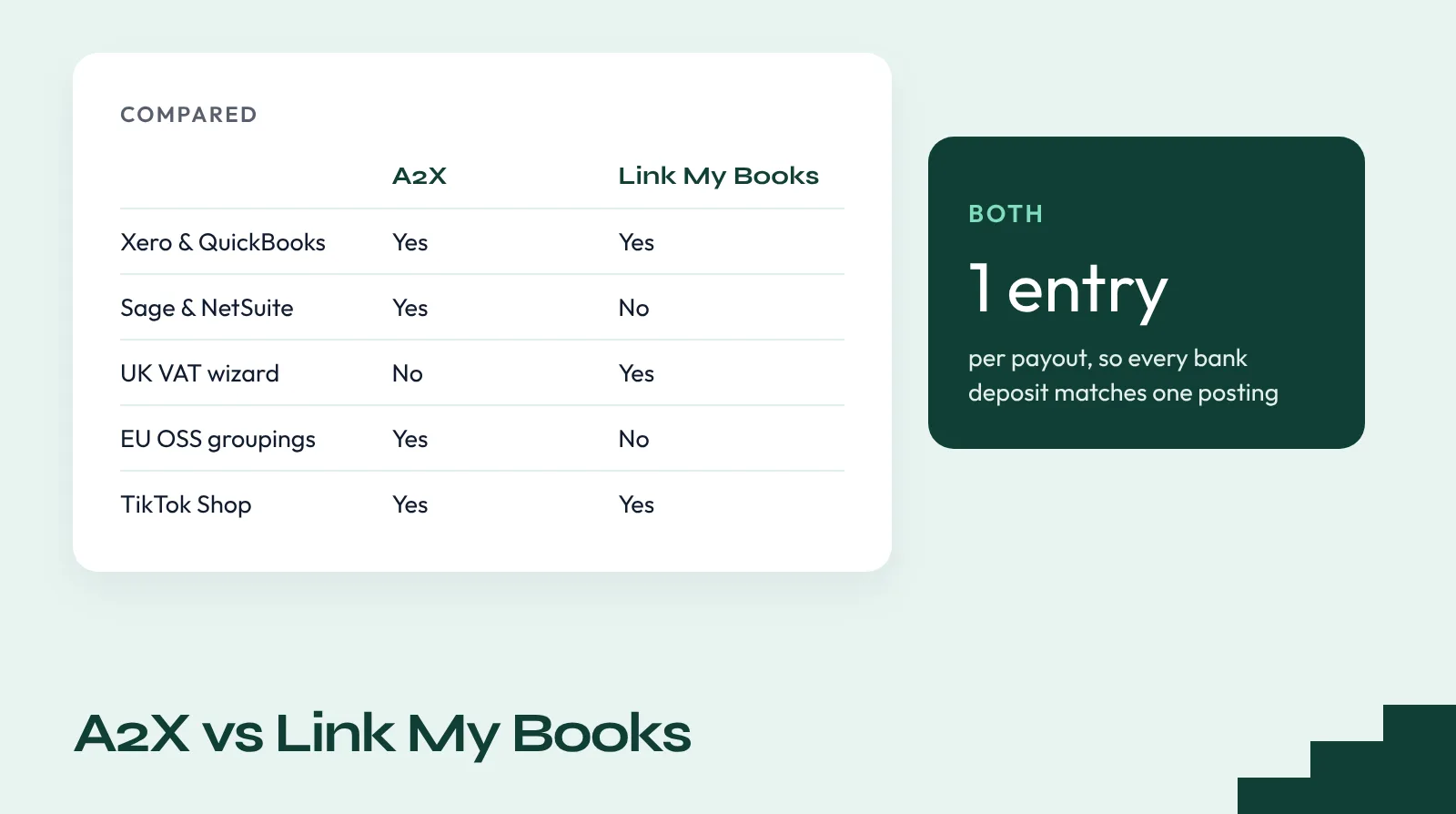
A2X and Link My Books both turn marketplace and Shopify payouts into clean summary entries in Xero or QuickBooks, so each bank deposit matches one posting. Link My Books is UK-built, with a guided UK VAT setup, cost of goods included and support for Square and WooCommerce. A2X connects to more ledgers, including Sage and NetSuite, groups EU sales for OSS reporting and is long established at high volumes.
- 01 · Sell Platforms Amazon, Shopify, TikTok Shop, eBay, Etsy
- 02 · Split A2X or Link My Books Each payout split into sales, fees, refunds, shipping and VAT
- 03 · Post Xero or QuickBooks Posted to a clearing account per channel, with bills from Dext
- 04 · Match Bank Each deposit matched to its payout, so nothing is missed
- 05 · Report Your numbers Margin by channel and product, cash flow and VAT
If you sell on Amazon, Shopify, TikTok Shop or eBay, the money arrives as payouts: sales minus fees, refunds, ads and shipping, often with VAT mixed in. Posting those as one sales figure is the most common bookkeeping mistake we see. A2X and Link My Books both exist to fix it.
We work with both every month, in Xero and QuickBooks. This guide sets out how they differ, so you can choose, or check you’re on the right one.
What both tools do
Both connect to your sales channels and to Xero or QuickBooks. When a payout is made, they break it into sales, fees, refunds, shipping and VAT, and post one summary entry to a clearing account. The bank deposit then matches that entry exactly.
That’s the core job, and both do it well. The differences are in the edges.
A2X vs Link My Books at a glance
| A2X | Link My Books | |
|---|---|---|
| Built for | Global sellers, from New Zealand | UK sellers first, from the UK |
| Accounting software | Xero, QuickBooks Online, Sage, NetSuite | Xero and QuickBooks Online |
| Sales channels | Amazon, Shopify, eBay, Etsy, TikTok Shop, Walmart | Amazon, Shopify, eBay, Etsy, TikTok Shop, Square, WooCommerce, Walmart (US) |
| UK VAT | Mapped through your tax rates | Guided UK VAT setup wizard |
| EU OSS | Groups sales by country for OSS reporting | Not a multi-country EU VAT engine |
| Cost of goods | Available on Basic plans and above | Included on standard plans |
| Multi-currency payouts | Posts in the payout currency where your Xero or QuickBooks plan supports multi-currency | Posts in the payout currency where your Xero or QuickBooks plan supports multi-currency |
| Pricing model | Per channel, by monthly orders, in US dollars | By order band and number of channels, in pounds |
Feature details checked against independent comparisons dated September and October 2026. Both tools update often, so check the vendor’s site before deciding.
Pros and cons
A2X
Pros
- Long track record with high-volume and multi-entity sellers
- Works with four ledgers, including Sage and NetSuite
- Groups EU sales in a way that supports OSS reporting
- Lots of configuration for complex setups
Cons
- More set-up decisions, so a steeper learning curve
- Priced per channel in US dollars, which adds up for multi-channel sellers
- Cost of goods isn’t on the entry plan
Link My Books
Pros
- Built for UK VAT, with a guided set-up
- Cost of goods included as standard
- Supports Square and WooCommerce as channels
- Lower starting price for smaller sellers
Cons
- Xero and QuickBooks Online only
- Doesn’t split EU OSS VAT by country
- Stripe and PayPal only as Shopify or WooCommerce gateways, not standalone
Which suits Amazon sellers?
Amazon is where the difference shows most. Amazon settlement data is the messiest of any channel: fees, advertising, refunds, reimbursements and reserves all netted into one payout, often across several marketplaces and currencies.
- Selling on Amazon UK only: both handle it well. Link My Books’ guided VAT setup is usually quicker to get right.
- Selling across Amazon’s EU marketplaces: A2X’s grouping of sales by country makes OSS reporting easier, and both can post euro payouts in euros.
- Amazon plus Shopify and TikTok Shop: compare the total cost for all your channels, because A2X charges per channel.
Which we’d usually recommend
Link My Books tends to suit UK brands on Xero or QuickBooks selling mainly to UK customers across Shopify, Amazon and TikTok Shop, especially if VAT is where things have gone wrong before.
A2X tends to suit sellers using Sage or NetSuite, those registered for EU OSS, groups with several companies, or very high order volumes.
If you already use one and it’s set up properly, there’s rarely a reason to switch. Changing tools costs time; fixing the mapping usually gets you more.
Common mistakes with either tool
- Connecting a channel twice. If Shopify or Amazon also posts to Xero or QuickBooks through its own app, every sale is recorded twice.
- Mapping marketplace fees to the wrong accounts. Advertising, fulfilment and referral fees all in one account hides which channel actually makes money.
- Leaving the clearing account unchecked. It should come back to nil as payouts clear. A growing balance means a payout hasn’t matched.
- Switching tools mid-quarter. Swap at the start of a month or VAT quarter, with the old tool’s clearing accounts at nil, so nothing is posted twice or missed.
- Letting cost of goods go stale. Margin is only as accurate as the product costs loaded, so update them when supplier prices, freight or duty change.
“Both tools are only as good as the set-up behind them. Most of the errors we fix aren’t the software’s fault: they’re a clearing account nobody checks, or a VAT rate mapped wrong on day one.”
Alex Gillespie, ICAEW chartered accountant
Where an accountant fits
The software posts payouts. It doesn’t decide how fees should be classified, notice when a reserve hasn’t been released, or check your VAT return. Our reconciliation service sets up and checks A2X or Link My Books every month, alongside your payment processors and bank. Already using one? Book a discovery call and we’ll tell you whether it’s set up right.


