


Business banking for ecommerce brands: how to choose

Reviewed by Alex Gillespie
, ICAEW chartered accountant
In short
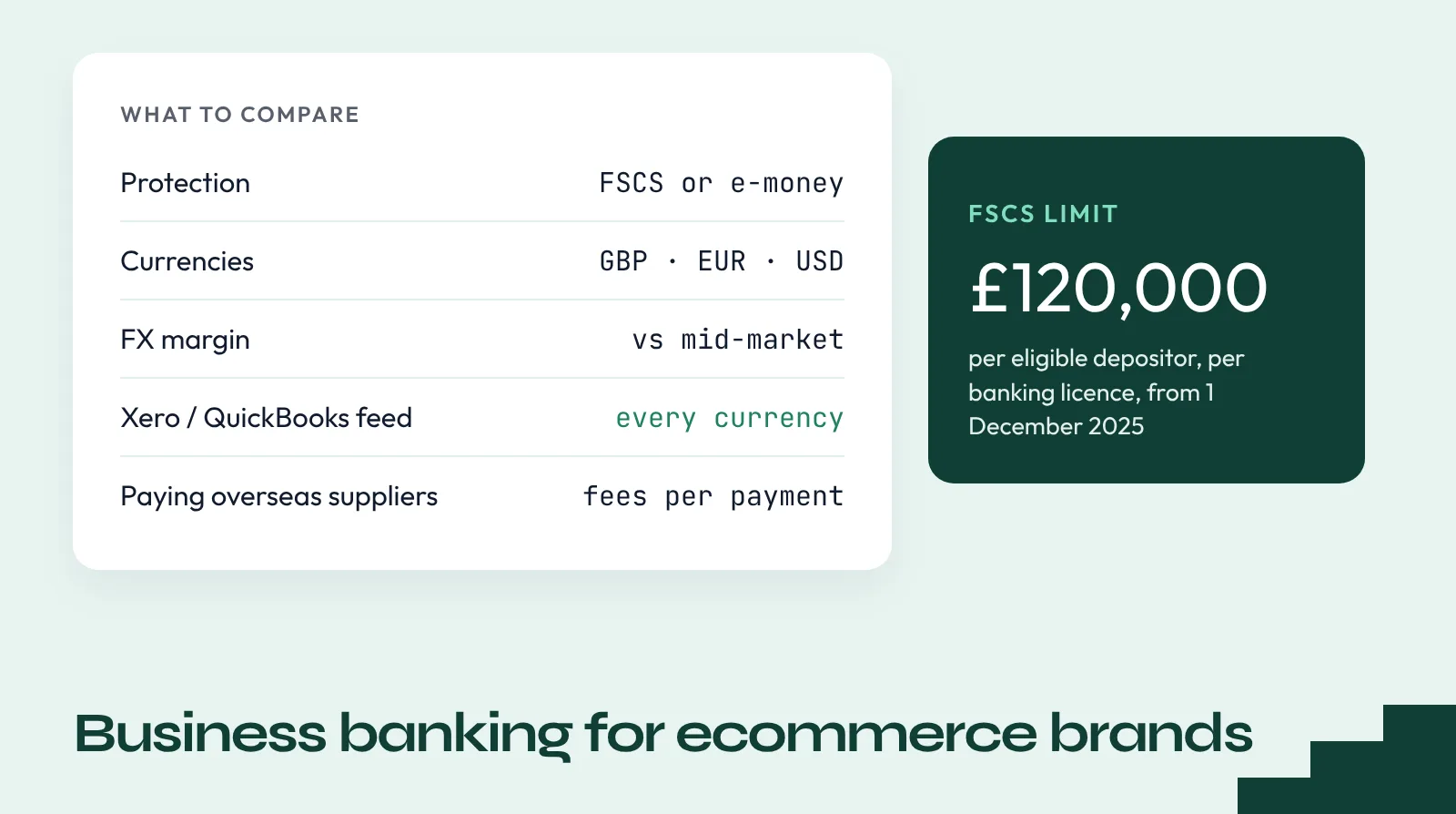
There is no single best business bank account for online sellers. Most growing brands use two: a UK bank account for day-to-day money and tax, protected by the FSCS up to £120,000, and a multi-currency account for euro and dollar payouts and paying overseas suppliers. The right pair depends on where you sell, the currencies you're paid in, and whether the account feeds cleanly into Xero or QuickBooks.
Banking is one of the first decisions an online brand makes, and one of the least revisited. The account you opened as a side hustle often isn’t the right one once you’re selling in euros, paying a factory in dollars and filing quarterly VAT.
This guide sets out what ecommerce brands should compare. We don’t recommend a single provider, and we don’t receive anything from any provider named here.
Do you need a separate business bank account?
If you trade through a limited company, yes in practice. The company is a separate legal entity, so its money must be kept apart from yours, and mixing them makes your accounts and your tax harder to get right.
If you’re a sole trader, the law doesn’t require one, but it’s still worth it. Keeping business and personal finances separate makes bookkeeping quicker and HMRC questions easier to answer, and many banks’ terms don’t allow business use of a personal account.
What online sellers need from banking
- Somewhere safe for everyday money and tax. Your main account, ideally with FSCS protection.
- Multi-currency receiving. Euro and dollar accounts so marketplaces and payment providers can pay you in the currency you sold in.
- Cheap foreign exchange. You choose when to convert, at a competitive rate, rather than the marketplace or card processor doing it for you.
- Paying overseas suppliers. Sending dollars or euros to manufacturers and freight forwarders without high fees.
- A clean feed into Xero or QuickBooks. Every account, in every currency, needs a reliable bank feed or the reconciliation breaks.
Banks and e-money accounts: the difference that matters
| UK bank | E-money account | |
|---|---|---|
| Examples | High-street banks, and digital banks such as Starling and Monzo | Wise Business, Airwallex |
| How your money is protected | FSCS, up to £120,000 per eligible depositor per banking licence | Safeguarding: held separately from the provider’s own money, not FSCS |
| Strengths | Protection, lending, a long-term banking relationship | Multi-currency accounts, low FX costs, paying suppliers abroad |
| Watch out for | FX costs and limited currency accounts on some banks | Not FSCS-protected; lending usually limited |
Some providers sit in between. Revolut became a fully licensed UK bank in March 2026 and is moving accounts across in stages, so check which entity holds yours. Tide offers both: accounts with ClearBank are FSCS-protected, while older e-money accounts are not. Your sort code tells you which.
What you’ll need to open a business bank account
- Your Companies House registration number, if you trade as a company
- Identity and address details for directors and significant shareholders
- A description of what you sell and where, including the marketplaces and payment providers you use
- Expected turnover, and the countries you’ll receive money from and pay suppliers in
Ecommerce businesses are often asked more questions than other applicants because money comes from marketplaces and overseas. Having your sales channels and supplier countries ready speeds things up.
A setup that works for most growing brands
Most of the brands we work with end up with something like this:
| Account | Used for |
|---|---|
| Main UK business account (a bank) | Shopify and UK marketplace payouts, wages, rent, UK suppliers |
| Tax account (same bank) | A share of every payout set aside for VAT and Corporation Tax |
| Multi-currency account | Euro and dollar payouts, overseas suppliers, converting when the rate suits |
Keep the multi-currency balance at a working level and sweep surplus back to the protected bank account.
“The best banking setup is the one your bookkeeping can keep up with. Two well-run accounts with clean feeds beat five accounts nobody reconciles, whatever the FX rate.”
Alex Gillespie, ICAEW chartered accountant
Questions to ask any provider
- Is my money protected by the FSCS, or safeguarded as e-money?
- Which currencies can I receive in, with local account details?
- What’s the FX margin compared with the mid-market rate?
- Does it have a direct feed to Xero and QuickBooks for every currency?
- What are the monthly account fees, transaction fees and charges for international payments?
- Can the team have their own debit cards with spending limits?
- Does it offer lending, such as an overdraft, business loans or a credit card, if you need it later?
- Can I add users and set approval limits for the team?
How banking affects your accounts
Every account and currency is another feed to reconcile in Xero or QuickBooks, and every conversion creates an exchange gain or loss that belongs in your accounts. Our reconciliation service matches every payout across currencies, and our cash flow forecasting shows when tax and supplier payments fall due. Book a discovery call and we’ll look at whether your banking setup is working for you.


