


How much does an ecommerce accountant cost in the UK?

Reviewed by Alex Gillespie
, ICAEW chartered accountant
In short
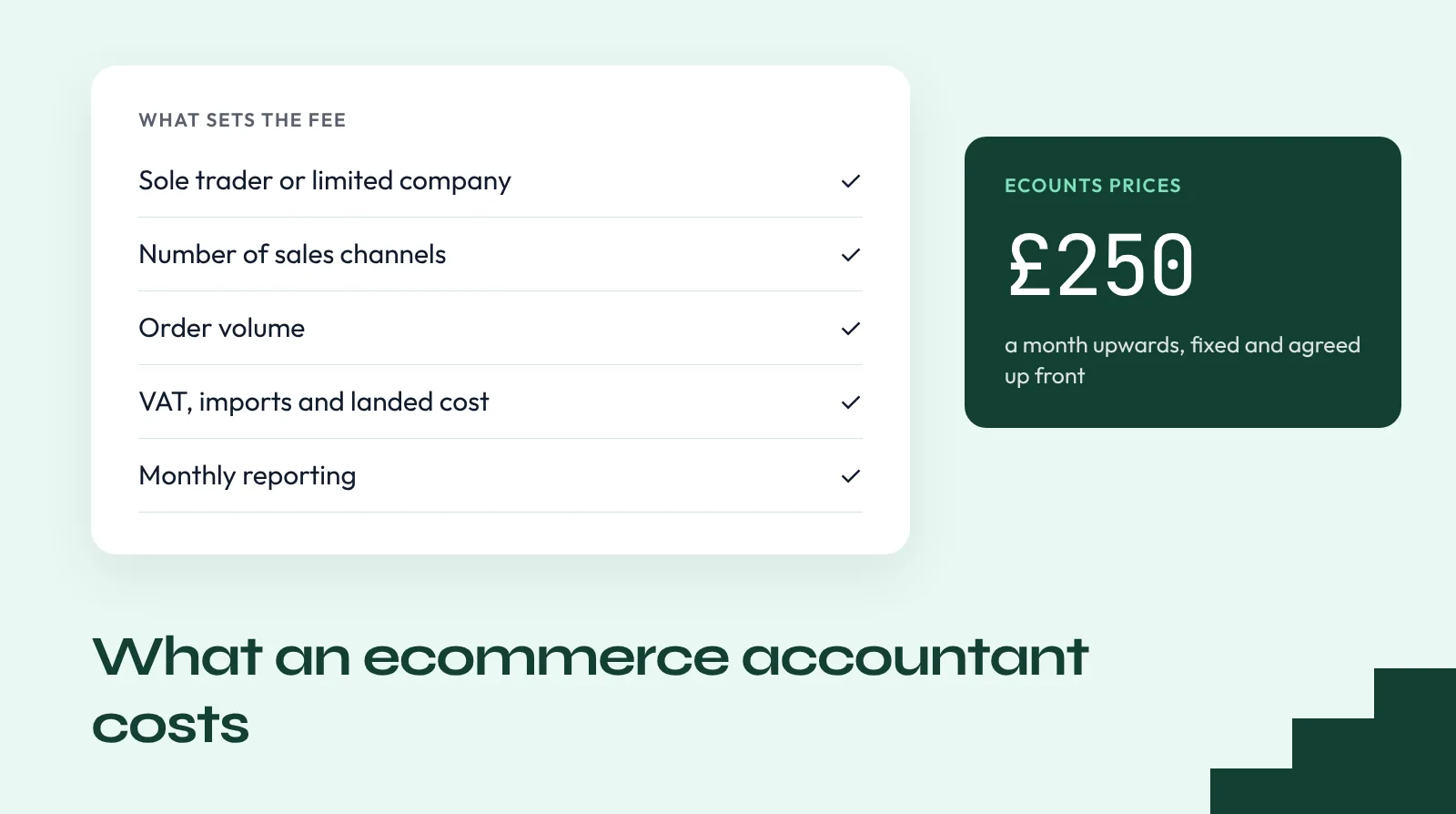
An ecommerce accountant's fee depends mainly on whether you're a sole trader or a limited company, how many platforms you sell on, your order volume, and whether you import or need monthly reporting. eCounts' published fees start at £250 a month for a sole trader and £590 for a limited company, with multi-platform sellers typically on £700 a month. When comparing quotes, check what's included: software, VAT returns, reconciliation, onboarding and directors' tax returns are where quotes differ most.
“How much will it cost?” is usually the first question an online seller asks an accountant, and the hardest one to compare. Quotes can look very different because they cover different work. This guide explains what drives an ecommerce accountant’s fee, what should be included, which extras to ask about, and how to compare quotes like for like.
For transparency, we use our own published prices as a reference throughout. Other firms will price differently, so treat them as one benchmark rather than the market rate.
What the fee usually covers
A good ecommerce accounting service covers the same core work, whatever it is called:
- Bookkeeping: every sale, fee, refund and expense recorded, usually monthly.
- Platform reconciliation: marketplace and payment payouts split into their parts and matched to the bank.
- VAT returns: prepared, checked and filed under Making Tax Digital, if you are VAT registered.
- Year-end accounts and tax returns: annual accounts plus a Corporation Tax return for a company, or a Self Assessment return for a sole trader.
- Advice: being able to ask a question without a separate bill.
Where firms differ is how much of the monthly work they do, how well they understand marketplace data, and what they charge on top.
What drives the price
| Factor | Why it changes the fee |
|---|---|
| Sole trader or limited company | A company needs statutory accounts, a Corporation Tax return and usually more work around directors’ pay |
| Number of sales channels | Each platform has its own settlement format, fees and timing to reconcile |
| Order volume | More orders mean more refunds, chargebacks and exceptions to check |
| VAT registration | Monthly or quarterly returns, plus checks on what is and isn’t reclaimable |
| Importing | Import VAT, duty and landed cost per product |
| Reporting | Monthly management accounts, margin by product or channel, cash flow forecasts |
| State of your records | Messy or missing history means catch-up work before the monthly service starts |
Our prices, as a reference
eCounts publishes its fees on our pricing page. Each tier includes everything in the one below:
| Tier | Monthly fee | Typical seller |
|---|---|---|
| Compliance | £250 (sole trader), £590 (limited company) | Accounts, tax returns, VAT and bookkeeping |
| Basic | £350 | One platform, up to 500 orders a month |
| Growth | £700 | Several platforms, with product-level costs and forecasting |
| Scale | From £2,500 | Seven-figure operations with management reporting |
| Fractional FD | From £4,500 | Board-level reporting and strategic finance |
Your Xero or QuickBooks subscription is included in every tier. If you’d like to see your own figure, our instant quote works it out from a few questions.
The extras to ask about
This is where quotes that look similar turn out to be very different. Ask every firm about each of these:
- Software. Is Xero or QuickBooks included? What about A2X or Link My Books, and Dext? These subscriptions can add a noticeable amount to your monthly costs if they’re billed separately.
- Onboarding and catch-up. Is there a setup fee? Who tidies up the months before they start? We quote onboarding after the discovery call, because it depends on your platforms and records.
- Directors’ tax returns. For a limited company, are the directors’ personal returns included? Ours are a fixed £200 each a year.
- Payroll and P11Ds. Included, or charged per payslip or per form?
- VAT returns. Included in the fee, or charged per return?
- Advice. Can you pick up the phone, or does every question start a timesheet?
- Who does the work. Is it the accountant you met, or is it outsourced?
How to compare quotes like for like
Put the quotes side by side and add up the real annual cost:
- the monthly fee multiplied by 12
- plus software subscriptions not included
- plus annual extras (personal tax returns, P11Ds, confirmation statement)
- plus a realistic allowance for ad hoc work billed by the hour
Then compare what you get for it. A quote that is £100 a month cheaper but doesn’t reconcile your platform payouts isn’t the same service. Our guide to why generic accountants cost ecommerce sellers more explains the errors we most often find when that reconciliation is missing, such as fees netted off sales, stock costs in the wrong year and VAT reclaimed that shouldn’t be.
Red flags in a cheap quote
- “We’ll just use your bank statement.” Marketplace payouts are net figures. Booking them as sales understates both your turnover and your costs, and can throw out VAT.
- No mention of A2X, Link My Books or settlement reports. Ask how they handle Amazon and Shopify data. The answer tells you a lot.
- Year-end only. If nobody looks at your figures until the year end, problems are found when they are hardest to fix.
- Everything is an extra. A low headline fee with hourly billing for every question can end up the most expensive option.
Is it worth it?
The fee is the visible cost. The less visible one is what poor accounting costs: VAT over or underpaid, margin you think you have but don’t, and tax bills that arrive as a surprise. Most sellers who come to us aren’t looking for the cheapest accountant. They’re looking for one who understands their numbers.
If you’re thinking of changing, our guide on how to switch accountants shows how the handover works. To talk through your own setup and get a fixed price, book a free discovery call.


